By Glenn Agung Hole, Ph.D.
Modern economics has traditionally focused on the allocation of scarce resources and the production and distribution of wealth. While these questions remain important, they overlook a more fundamental one:
How do societies continuously reproduce the capacity to create prosperity across generations?
Institutional Capital Theory proposes that long-term prosperity is not primarily a function of natural resources, financial wealth, or technological progress. Rather, it depends upon the continuous reproduction of institutions that sustain productive incentives, adaptive knowledge, entrepreneurship, innovation, trust, and effective governance.
Institutional Capital therefore represents the accumulated productive capacity embedded within a society's institutional architecture. It is not merely another form of capital alongside physical, financial, human, or social capital. It is meta-capital—the coordinating and enabling capital that determines how effectively every other form of capital is created, combined, allocated, and renewed.
Prosperity should therefore be understood not as a stock of accumulated wealth but as the outcome of a dynamic process of institutional reproduction. Wealth itself is merely a lagging indicator. The true source of national prosperity lies in a society's ability to regenerate the institutional conditions that continually produce new wealth.
This perspective fundamentally shifts economic analysis from production to reproduction. The central analytical question is no longer simply how wealth is created, but how the institutional capacity to create wealth is continuously renewed despite technological disruption, demographic change, political cycles, and geopolitical competition.
Institutional Capital Theory identifies a self-reinforcing cycle:
Knowledge → Institutions → Incentives → Entrepreneurship → Innovation → Productivity → Prosperity → Institutional Investment → New Knowledge
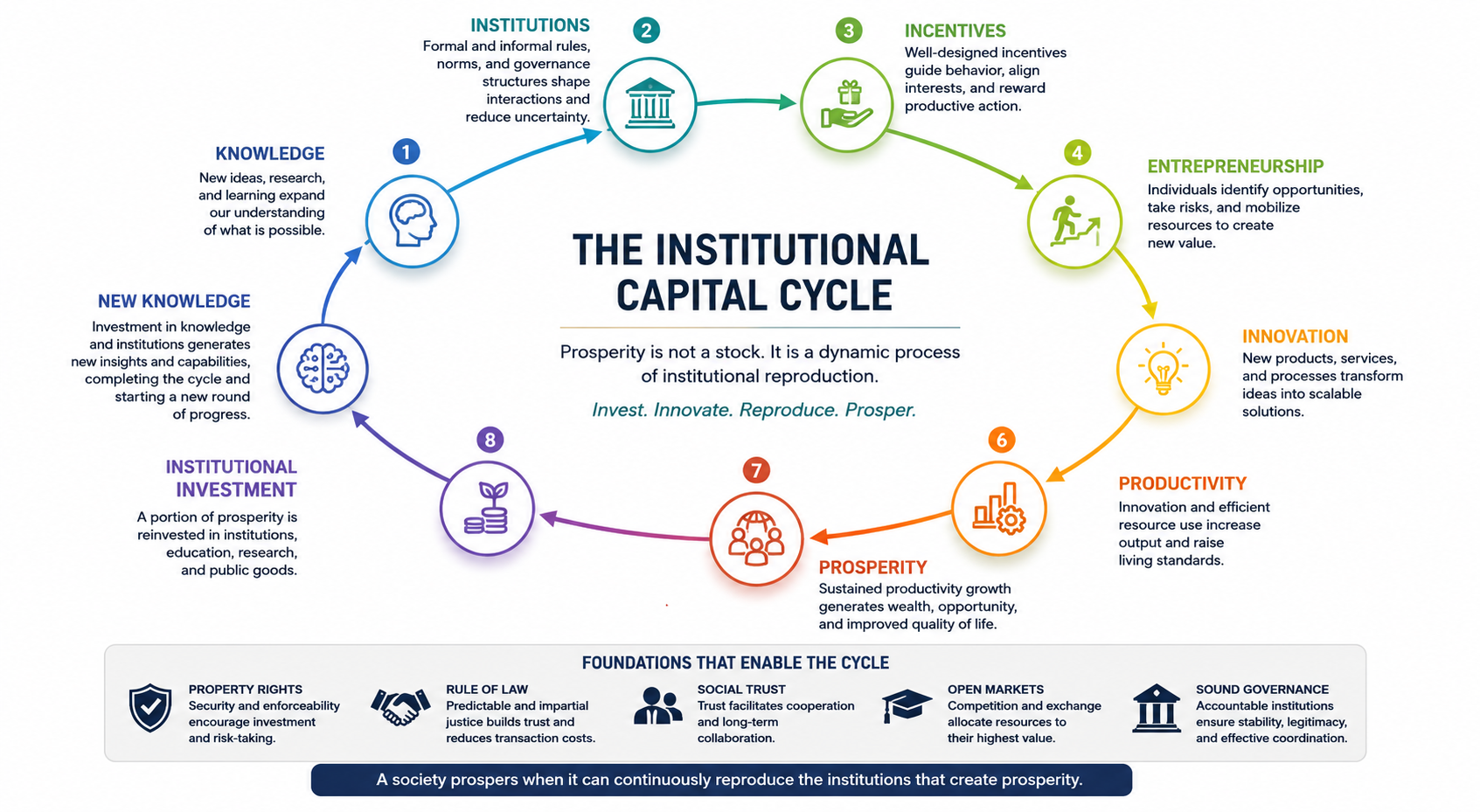
Each stage reinforces the next. As institutional quality improves, societies experience what may be described as Institutional Compounding: a cumulative process in which stronger institutions generate higher trust, more productive investment, greater innovation, and enhanced adaptive capacity, thereby strengthening the institutions themselves.
The opposite process is equally important. Institutional decline rarely results from sudden collapse. Instead, it emerges through Institutional Depreciation—the gradual erosion of incentives, governance quality, property rights, educational excellence, entrepreneurial culture, strategic competence, and long-term investment horizons. Individual policy decisions may appear insignificant in isolation, yet collectively they can weaken a nation's productive capacity over decades.
Knowledge production constitutes one of the most critical forms of institutional investment. Universities, research institutions, think tanks, educational systems, and intellectual networks do far more than produce information. They construct the conceptual frameworks through which societies interpret economic reality. Ideas become institutions; institutions shape incentives; incentives ultimately determine economic performance.
This creates what may be termed Institutional Asymmetry. Societies or political movements that systematically invest in research, education, intellectual infrastructure, and long-term knowledge production gradually shape the dominant understanding of economic reality. Influence is therefore accumulated not only through political power but through the institutional production of ideas.
From this perspective, taxation, regulation, welfare systems, immigration policy, environmental policy, education, industrial strategy, and innovation policy are not independent policy domains. They are institutional variables that either strengthen or weaken a society's capacity to reproduce prosperity.
The central proposition of Institutional Capital Theory is therefore straightforward:
Prosperity is not inherited. It is institutionally reproduced.
This proposition leads to three foundational principles.
The First Principle of Institutional Capital: Institutions that are not continuously renewed inevitably depreciate.
The Second Principle of Institutional Capital: Sustainable redistribution depends upon the prior reproduction of productive institutional capacity.
The Third Principle of Institutional Capital: The most enduring form of strategic power is the ability to reproduce the institutions that generate future prosperity.
Institutional Capital Theory therefore offers more than an economic framework. It provides an interdisciplinary theory connecting institutional economics, entrepreneurship, innovation studies, public governance, strategic management, political economy, and geopolitics through a single explanatory mechanism: the continuous reproduction of institutional capacity.
The defining question of the twenty-first century is therefore not which societies possess the greatest wealth today. It is which societies possess the strongest capacity to reproduce the institutions that will generate prosperity tomorrow.