Migration has become one of the defining public policy challenges of the twenty-first century. Political debate is frequently dominated by questions of border control, asylum systems, integration, and humanitarian obligations. From the perspective of institutional economics, however, these discussions address only part of the challenge. The more fundamental question is this:
How can a state design a migration policy that strengthens national productivity, institutional capacity, and long-term strategic competitiveness?
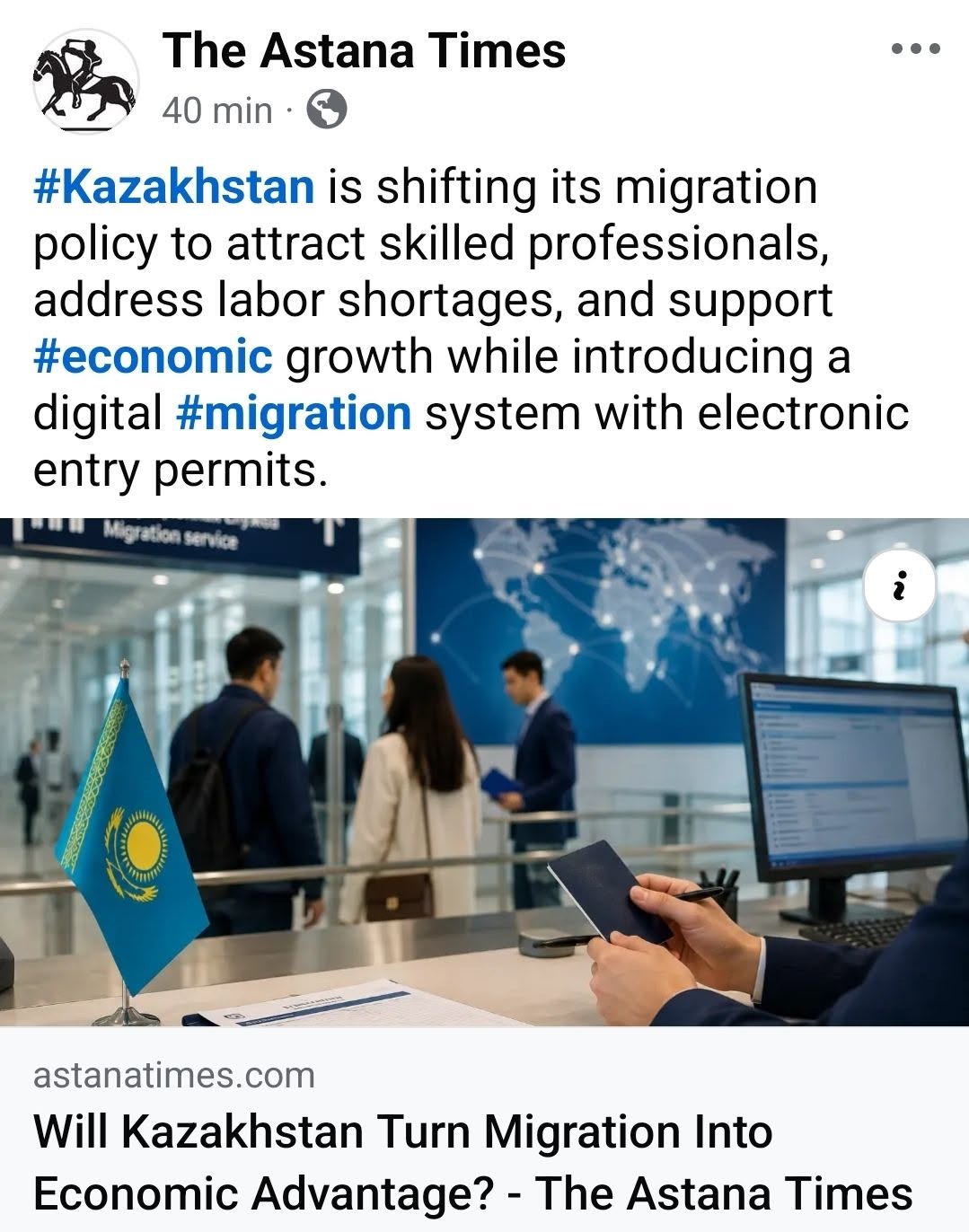
Kazakhstan's recent migration reforms provide an interesting case study. Rather than treating migration primarily as a matter of border management, the reforms seek to position migration as an instrument of economic modernization, state-building, and institutional development. The objective is not migration as an end in itself, but the targeted attraction of skills and expertise that address documented labour market shortages and support the country's long-term development strategy.
This represents a transition from migration control to strategic migration governance. Admission is increasingly linked to qualifications, labour market demand, and national development priorities. At the same time, Kazakhstan is investing in digital migration management, more efficient administrative procedures, and mechanisms that encourage knowledge transfer between international specialists and domestic professionals. Migration therefore becomes an integrated component of industrial policy, innovation policy, and institutional development.
Labour as institutional capital
From an institutional perspective, labour is far more than a factor of production. Individuals also transfer tacit knowledge, professional norms, managerial experience, organisational routines, technological expertise, entrepreneurial capabilities, and international networks. Together, these intangible assets constitute what may be described as Institutional Capital—the accumulated stock of organisational knowledge, governance capability, professional norms, trust, and institutional routines that enables societies to reproduce productive capacity, innovation, and resilience across generations.
History demonstrates that the world's most successful economies have never competed solely for financial capital or natural resources. They have competed for people. From the Dutch commercial republics of the seventeenth century to Britain's Industrial Revolution and today's global innovation centres, long-term prosperity has depended upon the ability to attract, integrate, and develop individuals possessing valuable knowledge, entrepreneurial talent, and organisational experience. The decisive difference has been the presence of institutions capable of transforming individual competence into enduring national capability.
The principal challenge, therefore, is not attracting talent. Many countries are capable of doing so. The decisive factor is the state's absorptive capacity—its ability to integrate, develop, diffuse, and reproduce knowledge throughout businesses, universities, public institutions, and society more broadly. Human capital creates lasting economic value only when individual expertise is transformed into collective institutional capability. Migration should therefore not be understood merely as demographic policy, but as a mechanism for the reproduction of Institutional Capital.
Distinguishing humanitarian and skills migration
This also illustrates why it is essential to distinguish between labour and skills migration and humanitarian migration. Humanitarian migration is rooted in international legal and humanitarian obligations and serves fundamentally different objectives from labour migration, which is designed to address specific skills shortages, strengthen productivity, and enhance national competitiveness. When these distinct policy objectives are treated as a single political category, governments risk developing policies that are insufficiently targeted and less effective in achieving either humanitarian or economic goals.
It is precisely in this respect that Kazakhstan's reforms deserve attention. They point toward a model in which labour and skills migration are directly linked to documented shortages within the economy, productive labour market participation, and systematic knowledge transfer. Migration is therefore evaluated not simply according to who enters the country, but according to how human capital can be transformed into long-term institutional and economic capacity.
Implications for Norway and the European Union
These developments also raise broader questions for Norway and the European Union. Several European countries have in recent years experienced significant challenges related to integration, pressure on public services, and comparatively weak labour market participation among parts of the migrant population. At the same time, employers across healthcare, engineering, manufacturing, construction, technology, and other strategic sectors continue to report persistent shortages of highly qualified workers. These parallel developments demonstrate the importance of distinguishing more clearly between humanitarian migration and a strategically designed labour and skills migration policy based upon documented economic needs.
From an institutional economics perspective, this is not an argument for reducing humanitarian commitments. Rather, it is an argument for recognising that different forms of migration pursue different objectives and therefore require different policy instruments. Humanitarian protection should continue to fulfil its legal and moral purpose. Labour and skills migration, by contrast, should be designed as a strategic policy instrument capable of strengthening productivity, innovation, fiscal sustainability, and institutional resilience through the targeted attraction of competencies that contribute directly to national development.
In an era increasingly defined by geo-economic competition, the strength of states will depend upon their ability to identify, attract, integrate, retain, and continuously develop strategic human capital. Economic competitiveness is no longer determined solely by capital, technology, or natural resources, but by institutions capable of transforming human expertise into sustained productivity, innovation, and organisational learning.
Kazakhstan's reforms therefore illustrate a broader institutional insight. Migration should not primarily be evaluated according to the number of people crossing a border, but according to the capacity of the state to transform human mobility into Institutional Capital. When labour and skills migration is aligned with documented economic needs, effective governance, and systematic knowledge transfer, migration becomes an integral component of long-term state-building and economic development.
For Norway and the European Union, the principal lesson is not to replicate Kazakhstan's policies, but to develop a clearer strategic distinction between humanitarian migration and labour and skills migration. Humanitarian obligations should continue to be respected and fulfilled. At the same time, labour and skills migration should be designed more explicitly as a strategic instrument for addressing documented economic needs, strengthening productivity, and building the Institutional Capital that will ultimately determine which states succeed in achieving sustained innovation, economic resilience, and long-term prosperity in the twenty-first century.