By Dr. Glenn Agung Hole
Institutional Economist and Geopolitical Analyst
Astana, Kazakhstan | 22 August 2026
Kazakhstan's emerging development model suggests that artificial intelligence, universities, energy, digital government and infrastructure are being treated not as separate policy fields, but as components of a broader attempt to accumulate institutional capability.
ASTANA — Much of the international debate about artificial intelligence is framed as a technological race: who develops the strongest models, attracts the most investment, builds the largest data centres or secures access to advanced semiconductors.
Kazakhstan presents a somewhat different and potentially instructive case.
Its emerging strategy suggests that artificial intelligence is increasingly being treated not primarily as a technology policy, but as part of a broader project of institutional capacity building.
That distinction matters.
Technology alone does not generate sustained economic transformation. Artificial intelligence requires electricity, digital infrastructure, skilled labour, universities capable of producing and absorbing knowledge, firms capable of commercialising research, access to capital and public institutions capable of adapting regulation and administrative systems.
When these elements develop separately, technological investment risks becoming fragmented. When they develop together, they can become mutually reinforcing.
From an institutional-capital perspective, therefore, the relevant question is not simply how much Kazakhstan invests in technology, education or infrastructure. It is whether these investments accumulate into durable capabilities that can be reproduced across institutions and over time.
This is increasingly the more interesting dimension of Kazakhstan's development trajectory.
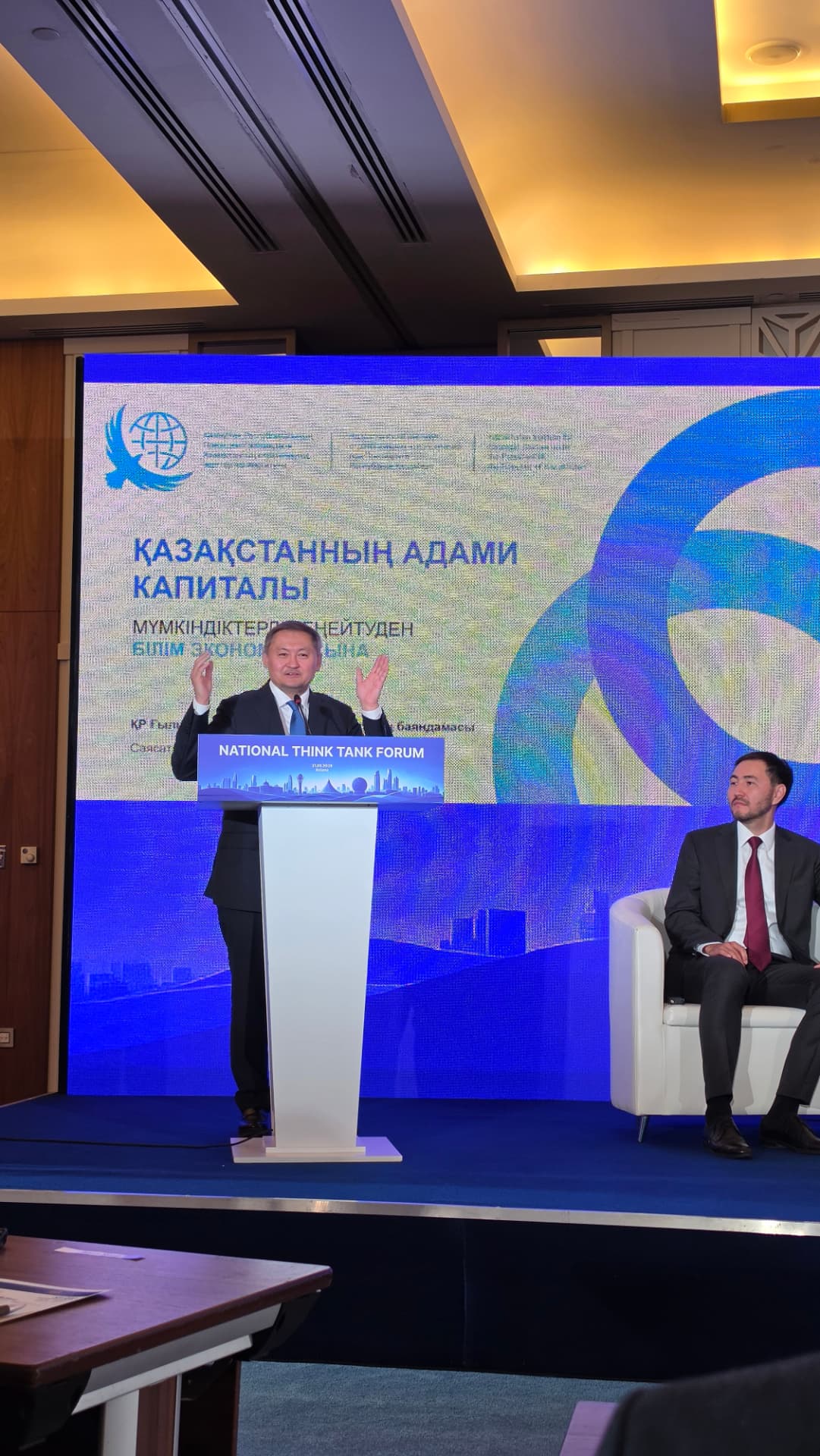
Discussions at the National Think Tank Forum in Astana, held under the theme "Forecasting the Future: From Assessing Results to a New Agenda," illustrated how education, artificial intelligence, scientific research, digital government, energy and institutional reform are increasingly being discussed as components of the same transformation.
Having participated in the forum and in discussions with Kazakh and international academics, policy specialists and think-tank representatives, I found one feature particularly noteworthy: Kazakhstan appears increasingly concerned not simply with individual reforms, but with the institutional complementarities between them.
The relevant question is therefore no longer merely whether Kazakhstan is investing in artificial intelligence.
It is whether the country is constructing an institutional ecosystem capable of transforming technological investment into reproducible national capability.
Human capital before technological ambition
Kazakhstan's approach to artificial intelligence begins with an unusually broad conception of technological literacy.
According to figures presented in Astana, more than 706,000 students have undergone introductory AI training through the national AI-Sana programme. Twenty-seven universities have been selected for further development of the initiative, while 95 universities have incorporated more than 2,000 AI-related courses into their curricula.
The significance lies less in any individual number than in the underlying institutional logic.
Many countries approach AI primarily through specialised computer-science programmes, technology clusters or support for a relatively narrow group of companies. Kazakhstan appears to be attempting something broader: making AI competence increasingly horizontal across the higher-education system.
This reflects an important economic reality.
The productivity effects of general-purpose technologies rarely come from the technology alone. They emerge when organisations, workers and institutions reorganise themselves around new technological capabilities.
AI competence in engineering matters. But so does AI competence in logistics, medicine, agriculture, public administration, finance, energy and industrial production.
From this perspective, technological literacy becomes a form of national absorptive capacity: the ability of an economy not merely to import technology, but to understand, adapt, diffuse and deploy it productively.
The planned Qazaq AI Research University adds another layer to this architecture. The specialised institution is expected to receive its first cohort during the 2026–27 academic year and connect advanced AI education and applied research with strategic sectors of the economy.
If implemented effectively, this could create an institutional bridge between education, research and commercial application.
Universities as economic infrastructure
Kazakhstan's higher-education strategy deserves attention for another reason.
Universities are increasingly being treated not simply as educational institutions, but as components of national economic infrastructure.
Academic programmes are being revised against regional skills-demand assessments. Dual education and workplace training are expanding. Universities are experimenting with industrial doctorate models developed in cooperation with private companies.
Research expenditure has also increased, while policymakers are placing greater emphasis on commercialisation.
This represents a transition from a traditional linear model:
education → degree → employment
towards a more interconnected system:
education → research → industry → innovation → entrepreneurship → productivity.
That distinction is fundamental for countries attempting to reduce excessive dependence on natural resources.
Kazakhstan possesses considerable oil, gas, mineral and uranium resources. These remain important economic and geopolitical assets. But natural-resource wealth does not automatically produce sophisticated institutions, diversified industries or technological capability.
The central development challenge is therefore one of institutional conversion:
How effectively can resource wealth be transformed into productive and institutional capacity?
Higher education is one mechanism through which that conversion can occur.
The challenge is substantial. Kazakhstan's university population has expanded rapidly and could approach one million students after 2030. Expansion creates opportunities, but scale alone does not guarantee quality.
The real test will therefore be whether Kazakhstan can simultaneously increase educational capacity, maintain academic standards, strengthen research quality and connect graduates more effectively with productive sectors.
AI ultimately becomes an energy question
There is another aspect of Kazakhstan's strategy that deserves considerably more international attention.
Artificial intelligence is physical.
Behind apparently weightless digital services stand data centres, electricity generation, transmission infrastructure, cooling systems, semiconductors and increasingly large capital investments.
The global AI race is therefore also becoming an energy and infrastructure race.
Kazakhstan appears to recognise this connection.
The country is simultaneously discussing AI development, data infrastructure, renewable electricity, grid modernisation and new nuclear generation. This is strategically important because technological ambition without sufficient energy capacity eventually encounters physical constraints.
The relationship can be expressed relatively simply:
AI capacity requires computing capacity.
Computing capacity requires data centres.
Data centres require reliable electricity.
Reliable electricity requires generation, grids, capital and long-term planning.
Energy policy can consequently no longer be separated neatly from technology policy.
Countries capable of coordinating these systems may acquire advantages extending far beyond electricity production itself.
Kazakhstan already possesses an unusual energy position. It combines substantial hydrocarbon resources with enormous uranium reserves, expanding renewable generation and ambitions for nuclear power.
This gives the country several possible pathways for supporting an increasingly electricity-intensive economy.
The strategic question is whether these resources can be converted into abundant, reliable and competitively priced energy for domestic industrial and technological development rather than remaining predominantly export assets.
From an institutional-capital perspective, the distinction is important. Possessing resources constitutes an endowment. Developing institutions capable of converting those resources into productive capacity constitutes capability.
The two should not be confused.
Digital government as institutional infrastructure
Kazakhstan's transformation is also occurring inside the state itself.
The country has developed extensive digital public services, and millions of citizens routinely interact with government through digital platforms.
But digitising existing administrative processes represents only the first stage.
The more consequential transition begins when databases become interoperable, administrative processes become increasingly automated and artificial intelligence is incorporated into public-sector decision support.
If successfully implemented, this could reduce transaction costs between citizens, companies and government.
For institutional economics, these costs matter enormously.
Time spent obtaining licences, registering companies, verifying documents, communicating with public agencies or navigating fragmented bureaucracies represents a genuine economic cost.
Digital government can therefore influence productivity not merely by making government more convenient, but by reducing the institutional friction surrounding economic activity.
Yet greater digital capacity simultaneously increases institutional responsibility.
Cybersecurity, privacy, algorithmic transparency, data governance and accountability become progressively more important as administrative systems become interconnected.
Digital state capacity without corresponding governance capacity can create new vulnerabilities.
State capacity is not the same as institutional quality
This distinction becomes particularly important when evaluating Kazakhstan's broader transformation.
Administrative efficiency, technological capability and infrastructure development represent important dimensions of state capacity. But they should not automatically be interpreted as evidence of broader institutional modernisation.
Greater state capacity can coexist with political centralisation.
Institutional development therefore cannot be measured solely by the state's ability to implement policy.
It must also be evaluated through the quality of oversight, accountability, institutional constraints, legal predictability and the ability of institutions to process disagreement and correct errors.
This distinction becomes particularly relevant as Kazakhstan enters a new constitutional phase.
The longer-term institutional test will be whether expanding technological and administrative capabilities are accompanied by credible oversight, accountability, contestability and institutional constraints on the exercise of power.
This is not unique to Kazakhstan. It represents a fundamental challenge for technologically ambitious states everywhere.
Digitalisation can strengthen administrative capability. Artificial intelligence can improve decision-making. Centralised coordination can accelerate infrastructure development.
But institutional capital becomes durable only when systems retain the capacity to learn, correct mistakes and reproduce competence beyond individual political leaders or administrative cycles.
The missing variable is institutional coordination
The most important feature of Kazakhstan's emerging model may therefore not be any individual investment.
It is the attempt to connect them.
Consider the architecture now taking shape:
- Education develops human capital.
- Research generates knowledge.
- AI expands technological capability.
- Universities connect skills with industry.
- Digital government reduces institutional transaction costs.
- Energy infrastructure supports computing and industrial capacity.
- Transport corridors connect production with international markets.
- Political and legal institutions determine whether the system can function predictably over time.
This is what distinguishes systemic transformation from a collection of projects.
Governments frequently announce innovation strategies, digitalisation programmes, universities, industrial policies and infrastructure investments independently.
The result can be impressive individual initiatives that nevertheless fail to create cumulative economic capability.
Institutional development depends on complementarities.
An advanced AI strategy without sufficient electricity eventually becomes constrained.
New universities without productive industries can produce graduate underemployment.
Research funding without commercialisation mechanisms produces knowledge without sufficient economic diffusion.
Infrastructure without predictable institutions raises investment risk.
Digital government without accountability can simply digitalise existing institutional weaknesses.
The quality of coordination between institutions therefore becomes at least as important as the quantity of investment within them.
Geography becomes more valuable when institutions improve
Kazakhstan's geography adds another dimension.
The country occupies a strategic position between China, Russia, the Caspian Sea and the wider European economic space. The expansion of the Trans-Caspian International Transport Route, commonly known as the Middle Corridor, has increased international interest in Kazakhstan as a Eurasian transport and logistics hub.
But geography alone does not create competitiveness.
A transport corridor becomes economically valuable when physical infrastructure is combined with efficient customs procedures, predictable regulation, digital logistics, financing, skilled labour and political stability.
The same institutional logic therefore applies to Kazakhstan's geographic position.
The country is not simply located between major markets.
It is attempting to increase the economic value of its geography through institutional capacity.
This also intersects with Kazakhstan's multi-vector foreign policy.
Its strategic position requires maintaining economic and political relationships with China, Russia, Europe, the United States, Türkiye, the Gulf states and other partners without becoming excessively dependent on any single external power.
Economic diversification and institutional capacity consequently have geopolitical implications.
The greater Kazakhstan's domestic technological, educational, energy and logistical capabilities become, the greater its potential room for strategic manoeuvre.
Institutional capital, in this sense, is not merely an economic asset.
It can become a component of geopolitical autonomy.
The Kurultai will test the institutional dimension
All of this is unfolding during a significant restructuring of Kazakhstan's political institutions.
The transition to a 145-member unicameral Kurultai establishes a new parliamentary architecture. The election on 23 August is therefore important not merely because representatives are being elected, but because the new institution will eventually have to demonstrate how effectively it performs its legislative, representative and oversight functions.
Technological modernisation and political institutionalisation should not be treated as separate processes.
Investment requires predictability.
Innovation requires credible rules.
Entrepreneurship requires confidence in institutions.
Advanced digital government requires accountability.
Foreign and domestic investors need confidence that regulatory frameworks will remain understandable and enforceable.
The ultimate measure of Kazakhstan's reforms will therefore not be the number of new programmes announced, universities established or digital systems introduced.
It will be whether institutional quality develops alongside technological capacity.
From resource economy to capability economy
Kazakhstan should consequently not be understood simply as attempting to diversify away from hydrocarbons.
Something more ambitious may be emerging.
The country is attempting to move from an economy whose strategic importance has historically rested heavily on what exists beneath its territory towards one increasingly shaped by what its institutions and people are capable of producing.
That is a much more difficult transition.
Oil can be extracted.
Uranium can be mined.
Infrastructure can be constructed.
Institutional capability must be accumulated, reproduced and renewed over time.
It depends on education, organisational competence, trust, predictable rules, technological absorption, research capacity, energy availability and the ability of political institutions to learn and adapt.
Kazakhstan has not completed this transformation, and substantial challenges remain.
Educational expansion must be matched by quality. Research commercialisation must become economically meaningful rather than administratively measured. Energy investment must keep pace with growing demand. Digitalisation must be accompanied by cybersecurity and accountability. Economic diversification must ultimately generate internationally competitive private enterprises. And greater administrative capacity must be accompanied by credible institutions capable of oversight and correction.
These are demanding tests.
But this is precisely why Kazakhstan deserves closer study.
The most interesting question is no longer whether the country can build individual elements of a modern economy.
It is whether it can connect those elements into a self-reinforcing institutional system capable of reproducing national capability across generations.
If Kazakhstan succeeds, its long-term strategic advantage may ultimately derive neither from oil nor uranium, nor even from its geographic position between China and Europe.
It may derive from something considerably harder to construct:
the institutional capital required to transform resources, knowledge, energy and geography into sustained national capability.
Analytical note
This analysis draws on the author's participation in the National Think Tank Forum in Astana on 21 August 2026, discussions with Kazakh and international academics, policy specialists and think-tank representatives, and publicly available information concerning Kazakhstan's higher-education, artificial-intelligence, digitalisation, energy and institutional reforms. Quantitative figures presented from the forum should be understood as reported programme and government data unless otherwise independently verified.
#Kazakhstan · #InstitutionalCapital · #KnowledgeEconomy · #AI · #Eurasia · #Kurultai